Tricky Puzzle: Fun Brain Story
- 3.5
- Rating
- 10.00M
- Installs
- Free
- Price

 Analysis by App-foxy
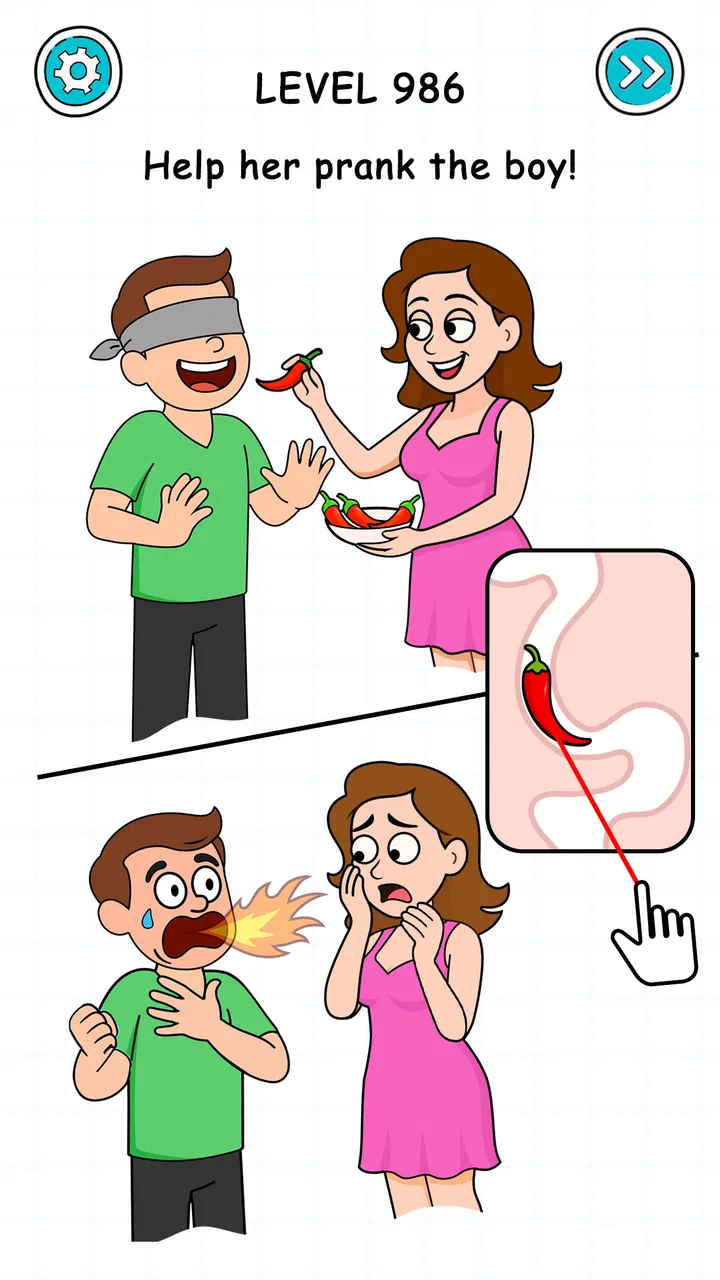
I went into Tricky Puzzle: Fun Brain Story expecting a light casual game for short breaks, and that is exactly where it makes the most sense. It turns ordinary situations into small logic challenges, asking me to look at a scene, question my first assumption, and try an unexpected interaction. The appeal is not a long adventure or a complicated rulebook. It is the quick satisfaction of spotting what the puzzle is really asking.
Created by Brames, this free game sits in the casual category but leans heavily on observation and lateral thinking. It is aimed at players who enjoy testing an idea, failing quickly, and trying again without a large penalty. I found it easy to start, yet the experience depends on whether the individual puzzle answers feel fair to you. Some solutions reward careful reading of the scene; others expect you to experiment with objects or actions that are not immediately obvious.
How the first goals shape the experience
The opening stretch works because the goals are simple to understand. I am usually not trying to manage a character, build a collection, or learn a large set of controls. Instead, I focus on the immediate situation in front of me and work out the action that moves it forward. That creates a clean first objective: solve the current brain teaser and see what the next scenario brings.
You May Also Like

 Google Keep - Notes and lists
Google Keep’s Quiet Growth Shows the Appeal of Simpler Notes
As mobile work gets busier, Google Keep keeps winning a simple contest: capture a thought quickly, find it later, and get on with the day.

 Blood Strike: 2.5 Anniversary
Blood Strike’s Loadouts Turn Every Drop Into a Tactical Gamble
A close look at Blood Strike’s custom loadouts: how fast access to signature weapons reshapes its battle royale rhythm, rewards preparation, and narrows the gap between fights.

 Pandora - Music & Podcasts
Pandora’s Music Is Easy to Start, but Harder to Recover
Pandora’s strength is its low-effort path from a seed to a station. Its weak spot is how much confidence it asks you to place in connection, setup, and quiet recovery.

 8 Ball Pool
 Is Built on Rivalries, Rematches, and Routine
A close look at the rivalries, rematches, shared routines, and unanswered safety questions that turn a quick pool match into a persistent mobile community.

 Samsung Music
’s Quiet Strength Is Playing What You Already Own
Its reach comes less from spectacle than from dependable access to a personal library. That simplicity is both the app’s strongest retention engine and its ceiling.

 AccuWeather: Weather Radar
AccuWeather Review: A Quick, Clear Forecast for Everyday Decisions
For everyday plans, the best forecast is the one you can understand quickly. AccuWeather makes rain timing, radar, and local conditions easy to act on, with a few trade-offs.
More From Our News Desk



This structure is useful for casual players because it removes preparation time. I can open the game during a short pause, understand the basic task, and begin experimenting almost immediately. The everyday setting also helps the puzzles feel approachable. Rather than presenting an abstract grid or a dense mathematical problem, the game frames its challenges as little stories, which gives each one a reason to exist.
The early goals are also a good test of patience. If you enjoy noticing small details, the format encourages you to inspect the whole screen before tapping randomly. If you prefer clearly explained rules and predictable logic, the same design can feel vague. I learned to treat the first attempt as observation rather than a commitment to one answer. That small change made the game feel less frustrating.
One practical tip is to read the wording and study the scene separately. A puzzle may appear to ask for a direct solution, while the useful clue is hidden in an object, a character’s position, or an unusual detail in the background. I also found it better to try a few deliberate interactions than to tap everywhere without a plan. Random tapping can eventually reveal an answer, but it removes much of the satisfaction and makes the harder moments feel noisier than they need to be.
Progress signals that keep short sessions moving
The most obvious progress signal is completing one scenario and reaching the next. That sounds modest, but it suits the game’s compact format. I always know what I am doing in the moment, and a solved puzzle gives a clear reason to continue for another round. The flow is especially comfortable when I want a few minutes of entertainment rather than a commitment to a long play session.
What matters here is the rhythm between discovery and payoff. A puzzle that takes only a little thought can still feel rewarding when the solution changes how I view the scene. The game’s story framing helps with that because completion is not only a checkmark; it also closes a small situation and opens another. I would not describe the progression as deep, but it is understandable and immediate.
For players who need extensive unlock trees, character upgrades, or a large collection of rewards, this may feel thin. The motivation comes primarily from curiosity and the desire to solve the next challenge. That makes the game less dependent on long-term accumulation and more dependent on the quality and variety of its scenarios. In my experience, this is a strength when I want mental stimulation, but a weakness when I am looking for a broader game system.
The current version is 0.7.2, so I approached the progression as an evolving casual puzzle experience rather than a finished, content-heavy campaign. The game has already attracted over ten million installs, which suggests that its quick scenario format reaches a wide audience. Its average rating is 3.7 from around seventeen thousand ratings, a combination that matches my impression: plenty of players will enjoy the accessible premise, while others may be less comfortable with the occasional trial-and-error solution.
Where the difficulty curve feels fair and where it asks for patience
The difficulty is not simply about making each puzzle more complicated. The bigger challenge is learning how the game thinks. Early scenarios teach me to question obvious actions, while later moments rely more on noticing an unusual relationship between items or interpreting the situation from a different angle. That creates a curve based on mindset as much as on complexity.
I appreciate this approach because it makes improvement feel personal. I am not only memorizing a control scheme; I am becoming better at checking assumptions. When I get stuck, I usually ask myself whether I am following the literal request too closely, ignoring a background detail, or assuming that an object has only one possible use. Those questions are more useful than simply repeating the same tap.
Still, the curve can feel uneven. A clever puzzle and an obscure puzzle are not always the same thing. When the intended solution depends on a very specific interaction that the scene does not clearly suggest, success can feel like guessing rather than reasoning. That is the main limitation I would warn about. Players who enjoy “aha” moments will likely forgive a few opaque steps; players who want every answer to be logically signposted may lose patience.
My best method for difficult scenes is to pause before using hints or restarting, if those options are available in the particular situation. I scan for anything that looks deliberately placed, then test one possibility at a time. I avoid changing several things at once because I want to know which action produced the result. This turns a frustrating puzzle into a small process of elimination and makes the eventual answer easier to remember.
Everyday use cases and the right kind of player
A realistic use case is a short wait at a bus stop. I can play one scenario, put the phone away, and return later without needing to reconstruct a complicated mission. The same applies to a coffee break or a few quiet minutes before bed. Because the game is built around individual brain teasers, it fits interruptions better than a title that demands a continuous match or a long story chapter.
I also think it works well as a shared puzzle game. Handing the phone to a friend and discussing what a scene might be hiding creates a simple social activity without requiring multiplayer features. One person may read the wording literally while the other notices the visual clue. That difference in perspective is often exactly what these puzzles need.
It is less suitable for someone seeking a traditional narrative adventure, a competitive leaderboard experience, or a deep strategy game. The everyday-story presentation gives the puzzles personality, but it does not turn them into a large role-playing journey. Likewise, if you dislike experimenting with unexpected taps, the game may feel less like solving and more like searching for the developer’s intended trick.
The Teen content rating is worth keeping in mind for families choosing a game for younger children. I would not treat the rating as a reason to avoid it automatically, but I would check the store presentation and decide whether the tone suits the intended player. The game is free to install, with in-app purchases priced at $1.99 per item, so I would also review purchase settings before handing the device to a child.
How it compares with familiar casual puzzle alternatives
Compared with a classic match-three game, this title asks for more attention and less repetition. A match-three alternative is usually easier to play with muscle memory: identify a move, make it, and continue through a familiar loop. Here, I have to interpret a situation before I act. That makes Brames’ game better for a quick reasoning break, while the match-three format is usually better when I want a soothing, nearly automatic activity.
Compared with a standard crossword or word puzzle, the emphasis is more visual and situational. I do not need to spend a long time building a vocabulary-based answer. Instead, I inspect a scene and test an idea. This gives it broader appeal for players who enjoy puzzles but do not want every challenge to depend on spelling or general knowledge.
Compared with a formal logic-puzzle app, the game is more playful and less rigorous. A dedicated logic collection may offer cleaner rules, carefully measured difficulty, and a stronger sense of mastery. Tricky Puzzle: Fun Brain Story is more interested in surprise and everyday scenarios. I would choose it for variety and quick amusement, not for systematic training in deduction.
That distinction also explains the game’s retention pressure. It does not need a complicated progression system to make me continue; the next unusual situation is enough when the puzzles are landing well. But there is a limit. If several answers in a row feel arbitrary, curiosity turns into irritation. The game’s ability to retain me therefore depends more on fair clue design and changing scenarios than on durable unlocks or long-term collection goals.
What encourages continued play, and what can interrupt it
The strongest reason to keep playing is the compact feedback loop: inspect, experiment, solve, and move on. I like that the game does not require a large investment before delivering a result. A successful answer gives me a small burst of satisfaction, and the story format creates enough curiosity to make the next scenario tempting.
The weaker side is that the same loop can become repetitive if the puzzle ideas do not vary enough. Since the core activity remains scene-based problem solving, the game needs fresh twists to maintain momentum. I would recommend playing in short sessions rather than forcing a long run. Stopping after a few puzzles keeps the experience feeling like a refreshing brain break instead of turning every unclear answer into a test of endurance.
Another useful habit is to separate a genuine dead end from a puzzle that needs a different perspective. If I have tried the obvious interaction several times, I stop repeating it and describe the goal in my own words. Then I look for an alternative interpretation. This is a more reliable workflow than tapping faster, and it helps preserve the game’s intended feeling of discovery.
There is also a practical trade-off around purchases. Since the game is free, it is easy to try without committing money. The optional items cost $1.99 each, so players who want to keep spending controlled should decide in advance whether they are comfortable buying assistance or other available items. I prefer to exhaust my own observations first, because solving the scene myself is the main reason I am playing.
My progression verdict
After spending time with it, I see Tricky Puzzle: Fun Brain Story as a casual brain game that succeeds when I want short, story-shaped challenges rather than a deep progression system. Its goals are immediate, its progress is easy to understand, and its difficulty mostly comes from learning to question the obvious. That makes it friendly to newcomers while still giving experienced puzzle players occasional moments of surprise.
My recommendation comes with a clear condition: enjoy experimentation. If you like examining a scene, testing an unconventional idea, and accepting that one or two answers may require patience, this is an easy game to keep nearby. If you need strict logic, transparent rules, or a substantial unlock structure, a dedicated puzzle collection will probably serve you better.
For me, the best way to use it is as a five-minute reset between demanding tasks. I would not choose it for a serious long-form challenge, but I would recommend it to a friend who wants something more mentally engaging than passive scrolling. The free entry point makes trying it simple, while the Teen rating and optional $1.99 purchases are details worth considering before sharing it with younger players.
In the end, the game’s progression is carried by curiosity rather than complexity. It asks me to solve one small story, then offers another chance to catch the trick. That is not an ambitious structure, but it is a coherent one. When the clues feel fair, the result is light, clever entertainment; when they feel too hidden, the experience loses its charm. My overall view is positive, with the strongest recommendation going to players who value quick lateral-thinking puzzles and do not mind a little trial and error.
FAQs for Tricky Puzzle: Fun Brain Story
01What is Tricky Puzzle: Fun Brain Story?
Tricky Puzzle: Fun Brain Story is a mobile game that challenges players with a variety of brain teasers and puzzles. Designed to enhance cognitive skills, it presents unique and unexpected challenges that require creative thinking to solve. The app is available for both Android and iOS devices, offering a fun blend of entertainment and mental exercise.
02How does Tricky Puzzle: Fun Brain Story enhance cognitive skills?
The game enhances cognitive skills by presenting puzzles that require logic, lateral thinking, and problem-solving abilities. Each level poses a different challenge, encouraging players to think outside the box. This engagement helps improve memory, attention, and critical thinking, making it an entertaining way to boost mental agility.
03Are there in-app purchases in Tricky Puzzle: Fun Brain Story?
Yes, Tricky Puzzle: Fun Brain Story offers in-app purchases. While the game itself is free to download and play, certain features, hints, or additional levels may require payment. These purchases are optional and are designed to enhance the gaming experience for those who wish to progress more quickly or access exclusive content.
04Is Tricky Puzzle: Fun Brain Story suitable for all ages?
Tricky Puzzle: Fun Brain Story is generally suitable for a wide range of ages, as it offers puzzles that can appeal to both younger players and adults. However, some puzzles might be complex for very young children. Parental guidance is recommended to ensure the content aligns with the child’s cognitive abilities and maturity level.
05Can Tricky Puzzle: Fun Brain Story be played offline?
Yes, Tricky Puzzle: Fun Brain Story can be played offline. This feature makes it convenient for users to enjoy the game without needing a constant internet connection, perfect for travel or areas with limited connectivity. However, certain features, like in-app purchases or social sharing, may require online access.
Pros
- Engaging brain-teasers for all ages.
- Colorful graphics enhance user experience.
- Frequent updates with new puzzles.
- Offline mode available for on-the-go play.
- Simple controls make it accessible.
Cons
- Ads can interrupt gameplay frequently.
- Some puzzles are too simplistic.
- Limited hints without purchase.
- Occasional bugs in certain levels.
- Requires internet for daily challenges.

Tricky Puzzle: Fun Brain Story
Gallery